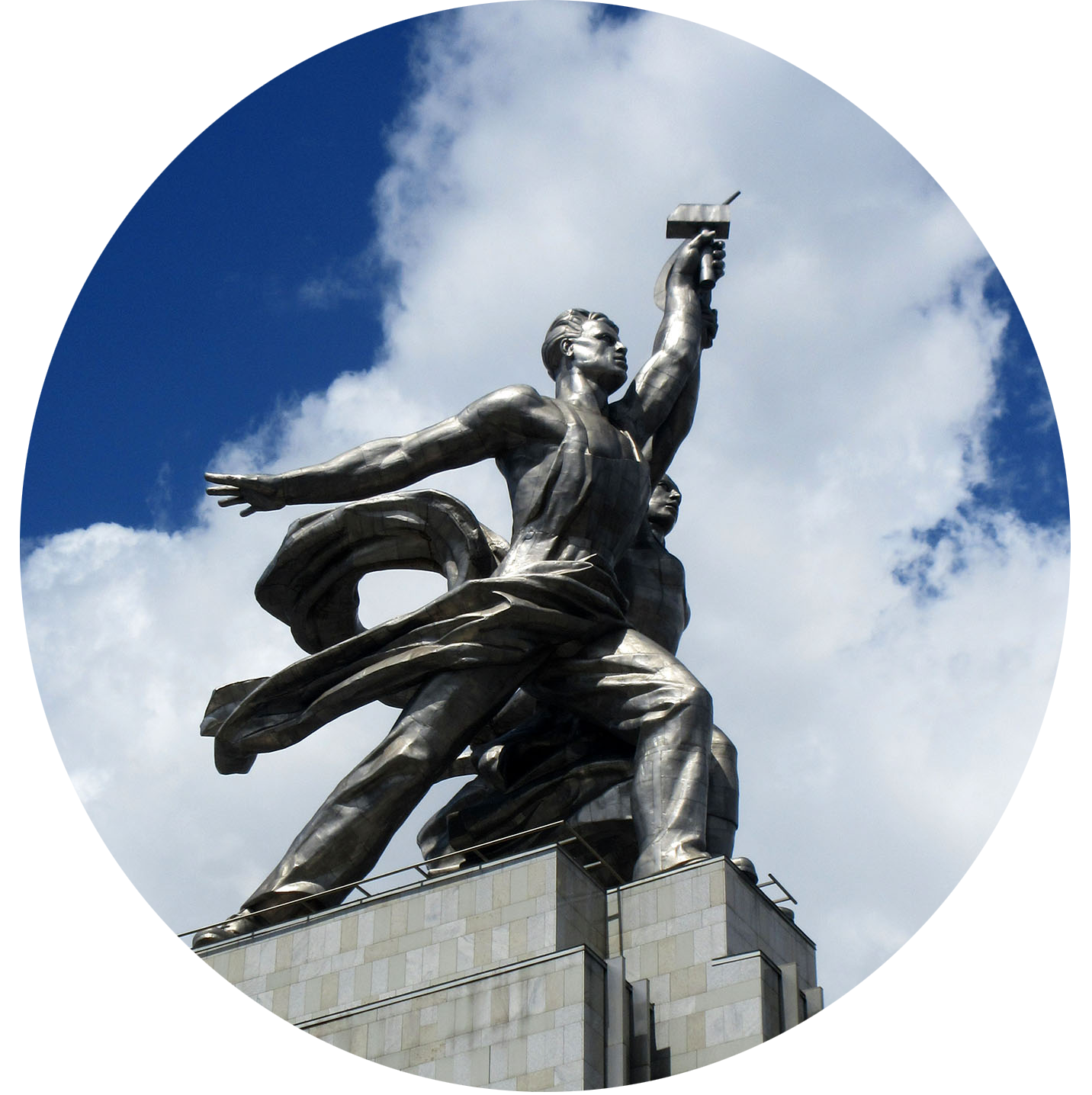
Pushkin: The Bronze Horseman
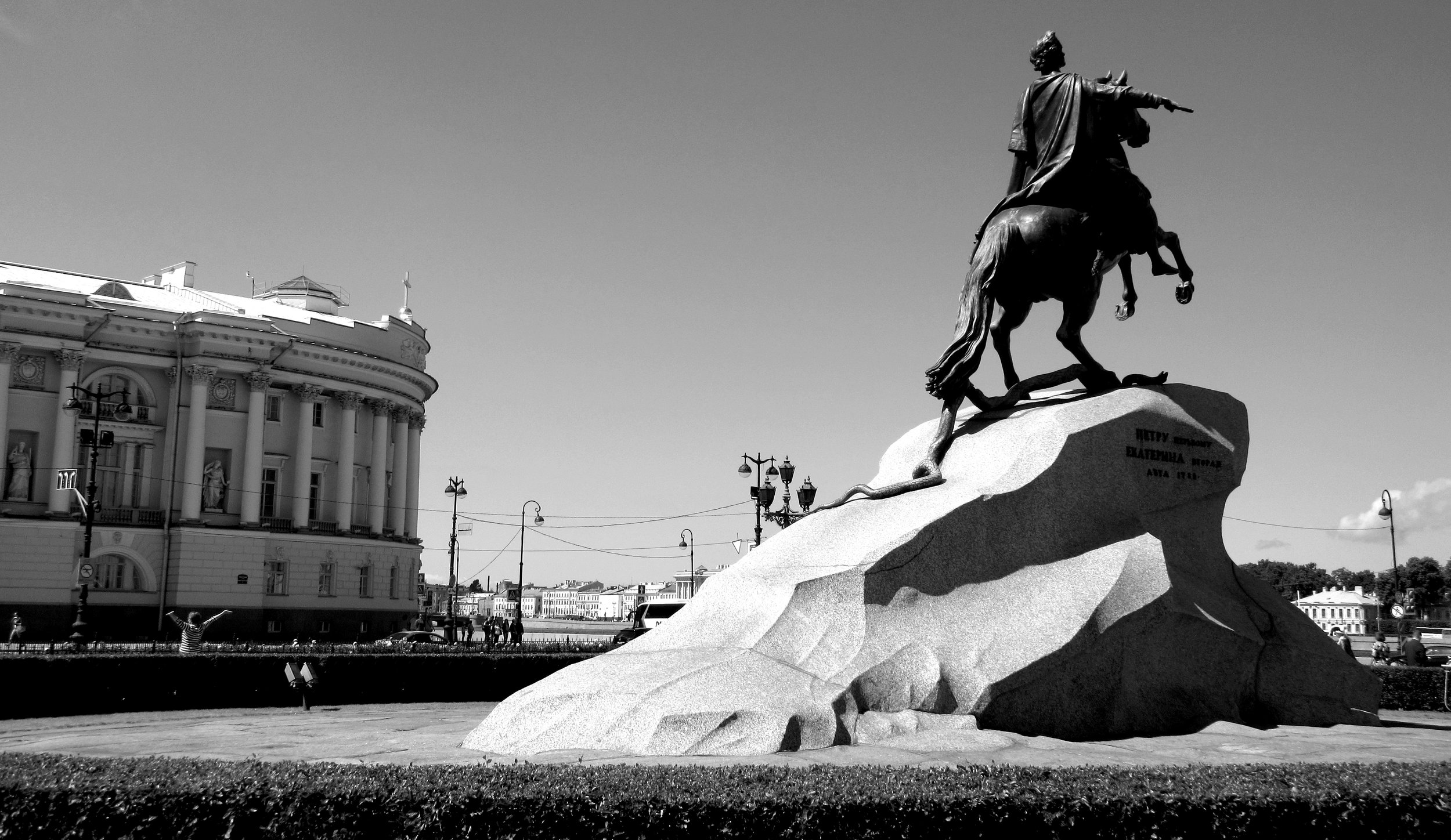
Here’s another translation from my upcoming anthology of Russian poetry. As usual, this is meant to be a learning tool, and thus seeks to illuminate the original Russian by remaining as faithful to its literal meaning as possible — while, of course, trying to make the English sound halfway decent.
Медный всадник
Вступление
На берегу пустынных волн
Стоял он, дум великих полн,
И вдаль глядел. Пред ним широко
Река неслася; бедный чёлн
По ней стремился одиноко.
По мшистым, топким берегам
Чернели избы здесь и там,
Приют убогого чухонца;
И лес, неведомый лучам
В тумане спрятанного солнца,
Кругом шумел.
И думал он:
Отсель грозить мы будем шведу,
Здесь будет город заложён
На зло надменному соседу.
Природой здесь нам суждено
В Европу прорубить окно,
Ногою твёрдой стать при море.
Сюда по новым им волнам
Все флаги в гости будут к нам,
И запируем на просторе.
Прошло сто лет, и юный град,
Полнощных стран краса и диво,
Из тьмы лесов, из топи блат
Вознёсся пышно, горделиво;
Где прежде финский рыболов,
Печальный пасынок природы,
Один у низких берегов
Бросал в неведомые воды
Свой ветхой невод, ныне там
По оживлённым берегам
Громады стройные теснятся
Дворцов и башен; корабли
Толпой со всех концов земли
К богатым пристаням стремятся;
В гранит оделася Нева;
Мосты повисли над водами;
Темно-зелёными садами
Её покрылись острова,
И перед младшею столицей
Померкла старая Москва,
Как перед новою царицей
Порфироносная вдова.
Люблю тебя, Петра творенье,
Люблю твой строгий, стройный вид,
Невы державное теченье,
Береговой её гранит,
Твоих оград узор чугунный,
Твоих задумчивых ночей
Прозрачный сумрак, блеск безлунный,
Когда я в комнате моей
Пишу, читаю без лампады,
И ясны спящие громады
Пустынных улиц, и светла
Адмиралтейская игла,
И, не пуская тьму ночную
На золотые небеса,
Одна заря сменить другую
Спешит, дав ночи полчаса.
Люблю зимы твоей жестокой
Недвижный воздух и мороз,
Бег санок вдоль Невы широкой,
Девичьи лица ярче роз,
И блеск, и шум, и говор балов,
А в час пирушки холостой
Шипенье пенистых бокалов
И пунша пламень голубой.
Люблю воинственную живость
Потешных Марсовых полей,
Пехотных ратей и коней
Однообразную красивость,
В их стройно зыблемом строю
Лоскутья сих знамён победных,
Сиянье шапок этих медных,
На сквозь простреленных в бою.
Люблю, военная столица,
Твоей твердыни дым и гром,
Когда полнощная царица
Дарует сына в царской дом,
Или победу над врагом
Россия снова торжествует,
Или, взломав свой синий лёд,
Нева к морям его несёт
И, чуя вешни дни, ликует.
Красуйся, град Петров, и стой
Неколебимо как Россия,
Да умирится же с тобой
И побеждённая стихия;
Вражду и плен старинный свой
Пусть волны финские забудут
И тщетной злобою не будут
Тревожить вечный сон Петра!
Была ужасная пора,
Об ней свежо воспоминанье…
Об ней, друзья мои, для вас
Начну своё повествованье.
Печален будет мой рассказ.
Часть первая
Над омрачённым Петроградом
Дышал ноябрь осенним хладом.
Плеская шумною волной
В края своей ограды стройной,
Нева металась, как больной
В своей постеле беспокойной.
Уж было поздно и темно;
Сердито бился дождь в окно,
И ветер дул, печально воя.
В то время из гостей домой
Пришёл Евгений молодой…
Мы будем нашего героя
Звать этим именем. Оно
Звучит приятно; с ним давно
Моё перо к тому же дружно.
Прозванья нам его не нужно,
Хотя в минувши времена
Оно, быть может, и блистало
И под пером Карамзина
В родных преданьях прозвучало;
Но ныне светом и молвой
Оно забыто. Наш герой
Живёт в Коломне; где-то служит,
Дичится знатных и не тужит
Ни о почиющей родне,
Ни о забытой старине.
Итак, домой пришед, Евгений
Стряхнул шинель, разделся, лёг.
Но долго он заснуть не мог
В волненье разных размышлений.
О чём же думал он? о том,
Что был он беден, что трудом
Он должен был себе доставить
И независимость и честь;
Что мог бы Бог ему прибавить
Ума и денег. Что ведь есть
Такие праздные счастливцы,
Ума недальнего, ленивцы,
Которым жизнь куда легка!
Что служит он всего два года;
Он также думал, что погода
Не унималась; что река
Всё прибывала; что едва ли
С Невы мостов уже не сняли
И что с Парашей будет он
Дни на два, на три разлучён.
Евгений тут вздохнул сердечно
И размечтался, как поэт:
«Жениться? Мне? зачем же нет?
Оно и тяжело, конечно;
Но что ж, я молод и здоров,
Трудиться день и ночь готов;
Уж кое-как себе устрою
Приют смиренный и простой
И в нём Парашу успокою.
Пройдёт, быть может, год-другой —
Местечко получу, Параше
Препоручу семейство наше
И воспитание ребят…
И станем жить, и так до гроба
Рука с рукой дойдём мы оба,
И внуки нас похоронят…»
Так он мечтал. И грустно было
Ему в ту ночь, и он желал,
Чтоб ветер выл не так уныло
И чтобы дождь в окно стучал
Не так сердито…
Cонны очи
Он наконец закрыл. И вот
Редеет мгла ненастной ночи
И бледный день уж настаёт…
Ужасный день!
Нева всю ночь
Рвалася к морю против бури,
Не одолев их буйной дури…
И спорить стало ей невмочь…
Поутру над её брегами
Теснился кучами народ,
Любуясь брызгами, горами
И пеной разъярённых вод.
Но силой ветров от залива
Переграждённая Нева
Обратно шла, гневна, бурлива,
И затопляла острова,
Погода пуще свирепела,
Нева вздувалась и ревела,
Котлом клокоча и клубясь,
И вдруг, как зверь остервенясь,
На город кинулась. Пред нею
Всё побежало, всё вокруг
Вдруг опустело — воды вдруг
Втекли в подземные подвалы,
К решёткам хлынули каналы,
И всплыл Петрополь как тритон,
По пояс в воду погружён.
Осада! приступ! злые волны,
Как воры, лезут в окна. Чёлны
С разбега стёкла бьют кормой.
Лотки под мокрой пеленой,
Обломки хижин, брёвны, кровли,
Товар запасливой торговли,
Пожитки бледной нищеты,
Грозой снесённые мосты,
Гроба с размытого кладбища
Плывут по улицам!
Народ
Зрит Божий гнев и казни ждёт.
Увы! всё гибнет: кров и пища!
Где будет взять?
В тот грозный год
Покойный царь ещё Россией
Со славой правил. На балкон,
Печален, смутен, вышел он
И молвил: «С Божией стихией
Царям не совладеть». Он сел
И в думе скорбными очами
На злое бедствие глядел.
Стояли стогны озерами,
И в них широкими реками
Вливались улицы. Дворец
Казался островом печальным.
Царь молвил — из конца в конец,
По ближним улицам и дальным
В опасный путь средь бурных вод
Его пустились генералы
Спасать и страхом обуялый
И дома тонущий народ.
Тогда, на площади Петровой,
Где дом в углу вознёсся новый,
Где над возвышенным крыльцом
С подъятой лапой, как живые,
Стоят два льва сторожевые,
На звере мраморном верхом,
Без шляпы, руки сжав крестом,
Сидел недвижный, страшно бледный
Евгений. Он страшился, бедный,
Не за себя. Он не слыхал,
Как подымался жадный вал,
Ему подошвы подмывая,
Как дождь ему в лицо хлестал,
Как ветер, буйно завывая,
С него и шляпу вдруг сорвал.
Его отчаянные взоры
На край один наведены
Недвижно были. Словно горы,
Из возмущённой глубины
Вставали волны там и злились,
Там буря выла, там носились
Обломки… Боже, Боже! там —
Увы! близёхонько к волнам,
Почти у самого залива —
Забор некрашеный, да ива
И ветхий домик: там оне,
Вдова и дочь, его Параша,
Его мечта… Или во сне
Он это видит? иль вся наша
И жизнь ничто, как сон пустой,
Насмешка неба над землёй?
И он, как будто околдован,
Как будто к мрамору прикован,
Сойти не может! Вкруг него
Вода и больше ничего!
И, обращён к нему спиною,
В неколебимой вышине,
Над возмущённою Невою
Стоит с простёртою рукою
Кумир на бронзовом коне.
Часть вторая
Но вот, насытясь разрушеньем
И наглым буйством утомясь,
Нева обратно повлеклась,
Своим любуясь возмущеньем
И покидая с небреженьем
Свою добычу. Так злодей,
С свирепой шайкою своей
В село ворвавшись, ломит, режет,
Крушит и грабит; вопли, скрежет,
Насилье, брань, тревога, вой!..
И, грабежом отягощённы,
Боясь погони, утомлённы,
Спешат разбойники домой,
Добычу на пути роняя.
Вода сбыла, и мостовая
Открылась, и Евгений мой
Спешит, душою замирая,
В надежде, страхе и тоске
К едва смирившейся реке.
Но, торжеством победы полны,
Ещё кипели злобно волны,
Как бы под ними тлел огонь,
Ещё их пена покрывала,
И тяжело Нева дышала,
Как с битвы прибежавший конь.
Евгений смотрит: видит лодку;
Он к ней бежит как на находку;
Он перевозчика зовёт —
И перевозчик беззаботный
Его за гривенник охотно
Чрез волны страшные везёт.
И долго с бурными волнами
Боролся опытный гребец,
И скрыться вглубь меж их рядами
Всечасно с дерзкими пловцами
Готов был чёлн — и наконец
Достиг он берега.
Несчастный
Знакомой улицей бежит
В места знакомые. Глядит,
Узнать не может. Вид ужасный!
Всё перед ним завалено;
Что сброшено, что снесено;
Скривились домики, другие
Совсем обрушились, иные
Волнами сдвинуты; кругом,
Как будто в поле боевом,
Тела валяются. Евгений
Стремглав, не помня ничего,
Изнемогая от мучений,
Бежит туда, где ждёт его
Судьба с неведомым известьем,
Как с запечатанным письмом.
И вот бежит уж он предместьем,
И вот залив, и близок дом…
Что ж это?..
Он остановился.
Пошёл назад и воротился.
Глядит… идёт… ещё глядит.
Вот место, где их дом стоит;
Вот ива. Были здесь вороты —
Снесло их, видно. Где же дом?
И, полон сумрачной заботы,
Всё ходит, ходит он кругом,
Толкует громко сам с собою —
И вдруг, ударя в лоб рукою,
Захохотал.
Ночная мгла
На город трепетный сошла;
Но долго жители не спали
И меж собою толковали
О дне минувшем.
Утра луч
Из-за усталых, бледных туч
Блеснул над тихою столицей
И не нашёл уже следов
Беды вчерашней; багряницей
Уже прикрыто было зло.
В порядок прежний всё вошло.
Уже по улицам свободным
С своим бесчувствием холодным
Ходил народ. Чиновный люд,
Покинув свой ночной приют,
На службу шёл. Торгаш отважный,
Не унывая, открывал
Невой ограбленный подвал,
Сбираясь свой убыток важный
На ближнем выместить. С дворов
Свозили лодки.
Граф Хвостов,
Поэт, любимый небесами,
Уж пел бессмертными стихами
Несчастье невских берегов.
Но бедный, бедный мой Евгений…
Увы! его смятённый ум
Против ужасных потрясений
Не устоял. Мятежный шум
Невы и ветров раздавался
В его ушах. Ужасных дум
Безмолвно полон, он скитался.
Его терзал какой-то сон.
Прошла неделя, месяц — он
К себе домой не возвращался.
Его пустынный уголок
Отдал внаймы, как вышел срок,
Хозяин бедному поэту.
Евгений за своим добром
Не приходил. Он скоро свету
Стал чужд. Весь день бродил пешком,
А спал на пристани; питался
В окошко поданным куском.
Одежда ветхая на нём
Рвалась и тлела. Злые дети
Бросали камни вслед ему.
Нередко кучерские плети
Его стегали, потому
Что он не разбирал дороги
Уж никогда; казалось — он
Не примечал. Он оглушён
Был шумом внутренней тревоги.
И так он свой несчастный век
Влачил, ни зверь ни человек,
Ни то ни сё, ни житель света,
Ни призрак мёртвый…
Раз он спал
У невской пристани. Дни лета
Клонились к осени. Дышал
Ненастный ветер. Мрачный вал
Плескал на пристань, ропща пени
И бьясь об гладкие ступени,
Как челобитчик у дверей
Ему не внемлющих судей.
Бедняк проснулся. Мрачно было:
Дождь капал, ветер выл уныло,
И с ним вдали, во тьме ночной
Перекликался часовой…
Вскочил Евгений; вспомнил живо
Он прошлый ужас; торопливо
Он встал; пошёл бродить, и вдруг
Остановился — и вокруг
Тихонько стал водить очами
С боязнью дикой на лице.
Он очутился под столбами
Большого дома. На крыльце
С подъятой лапой, как живые,
Стояли львы сторожевые,
И прямо в тёмной вышине
Над ограждённою скалою
Кумир с простёртою рукою
Сидел на бронзовом коне.
Евгений вздрогнул. Прояснились
В нём страшно мысли. Он узнал
И место, где потоп играл,
Где волны хищные толпились,
Бунтуя злобно вкруг него,
И львов, и площадь, и того,
Кто неподвижно возвышался
Во мраке медною главой,
Того, чьей волей роковой
Под морем город основался…
Ужасен он в окрестной мгле!
Какая дума на челе!
Какая сила в нём сокрыта!
А в сём коне какой огонь!
Куда ты скачешь, гордый конь,
И где опустишь ты копыта?
О мощный властелин судьбы!
Не так ли ты над самой бездной
На высоте, уздой железной
Россию поднял на дыбы?
Кругом подножия кумира
Безумец бедный обошёл
И взоры дикие навёл
На лик державца полумира.
Стеснилась грудь его. Чело
К решётке хладной прилегло,
Глаза подёрнулись туманом,
По сердцу пламень пробежал,
Вскипела кровь. Он мрачен стал
Пред горделивым истуканом
И, зубы стиснув, пальцы сжав,
Как обуянный силой чёрной,
«Добро, строитель чудотворный! —
Шепнул он, злобно задрожав, —
Ужо тебе!..» И вдруг стремглав
Бежать пустился. Показалось
Ему, что грозного царя,
Мгновенно гневом возгоря,
Лицо тихонько обращалось…
И он по площади пустой
Бежит и слышит за собой —
Как будто грома грохотанье —
Тяжёло-звонкое скаканье
По потрясённой мостовой.
И, озарён луною бледной,
Простёрши руку в вышине,
За ним несётся Всадник Медный
На звонко-скачущем коне;
И во всю ночь безумец бедный,
Куда стопы ни обращал,
За ним повсюду Всадник Медный
С тяжёлым топотом скакал.
И с той поры, когда случалось
Идти той площадью ему,
В его лице изображалось
Смятенье. К сердцу своему
Он прижимал поспешно руку,
Как бы его смиряя муку,
Картуз изношенный сымал,
Смущённых глаз не подымал
И шёл сторонкой.
Остров малый
На взморье виден. Иногда
Причалит с неводом туда
Рыбак на ловле запоздалый
И бедный ужин свой варит,
Или чиновник посетит,
Гуляя в лодке в воскресенье,
Пустынный остров. Не взросло
Там ни былинки. Наводненье
Туда, играя, занесло
Домишко ветхой. Над водою
Остался он как чёрный куст.
Его прошедшею весною
Свезли на барке. Был он пуст
И весь разрушен. У порога
Нашли безумца моего,
И тут же хладный труп его
Похоронили ради Бога.
The Bronze Horseman
Introduction
On a shore of deserted waters
Stood he, full of great thoughts,
And gazed into the distance. Before him, broadly,
The river drifted past; a poor skiff
Strove along it, all alone.
Along the mossy, boggy banks
Huts stood black, here and there,
The refuge of the wretched Finn;
And the forest, unknown to rays of light,
In the mist of a hidden sun,
Rustled all around.
And he thought:
From this position we shall menace the Swede;
Here, a city shall be founded
To spite our haughty neighbor.
By nature it is here ordained for us
To chop a window through to Europe,
To take our stance, with a firm foot, upon the sea’s edge.
Hither, along waves new to them,
All flags shall come to be our guests,
And we will feast in open freedom.
A hundred years passed, and the young city,
The beauty and wonder of the northern lands,
From the gloom of the forests, from the bog of the swamps,
Arose, magnificently and proudly;
Where before the Finnish fisherman,
That sad stepson of nature,
Alone, beside the low-flung banks,
Would cast, into uncharted waters,
His ramshackle sweep-net — there, now,
Along the animated banks
Crowd elegant masses
Of palaces and towers; ships,
Teeming from all ends of the earth,
Strive toward those wealthy piers;
The Neva has clothed herself in granite;
Bridges have appeared hanging above the waters;
With dark-green gardens
Her islands have been covered,
And before this younger capital
Old Moscow has faded,
As would, before a new tsaritsa,
A purple-wearing widow.
I love you, Peter’s creation,
I love your stern, elegant appearance,
The regal flow of the Neva,
The granite of her banks,
The cast-iron patterns of your fences,
And of your contemplative nights
The transparent twilight, the moonless shimmer,
When I, in my room,
Write and read without a lamp,
And bright are the sleeping masses
Of the deserted streets, and shining
Is the Admiralty spire.
And, not admitting the dark of night
Into the golden heavens,
One dawn, to replace another,
Races, having granted night just half an hour.
I love the unmoving air and frost
Of your harsh winter,
The racing of the sleighs along the broad Neva,
The girls’ faces, brighter than roses,
And the shimmer, and noise, and chatter of the balls,
And, at the hour of some bachelor’s banquet,
The hissing of the foamy glasses
And the light-blue flame of the punch.
I love the martial animation
Of your amusing Fields of Mars,
And of the hosts of infanty and steeds,
The monotonous beauty;
In their elegantly agitated ranks,
The scraps of these victorious banners,
The shining of these bronze helmets,
Shot through in battle.
I love, O martial capital,
The smoke and thunder of your fortress,
When the northern tsaritsa
Grants a son to the Imperial house,
Or when a victory over the enemy
Russia once again celebrates,
Or, having broken though its dark-blue ice,
The Neva bears it toward the seas,
And, sensing days of spring, exults.
Shine in beauty, Peter’s city, and stand
Unshakeably, like Russia;
And may the conquered element too
Make peace with you;
May the Finnish waves forget
Their long-standing enmity and captivity,
And may they not, with futile malice,
Trouble the eternal sleep/dream of Peter!
It was a terrible time;
Fresh is the memory of it...
Of it, my friends, for you
Will I now begin my narration.
Sad will be my tale.
Part One
Above darkened Petrograd
November breathed its autumn cold.
Spashing its noisy waves
Against the edges of its elegant walls,
The Neva writhed about like a sick man
In his restless bed.
It was already late, and dark;
The rain beat angrily at the window,
And the wind blew, howling mournfully.
At that time, returning home from a visit,
Young Yevgeny arrived...
We shall call our hero
By this name. It
Sounds nice; and, on top of that,
My pen is long since on friendly terms with it.
We have no need for his last name,
Although in times gone by
It may, perhaps, have figured gloriously,
And sounded in familial legends
Beneath the pen of Karamzin;
But today, by society and by rumor,
It has been forgotten. Our hero
Lives in Kolomna; he serves somewhere,
Avoids men of prominence, and grieves not
Over his deceased kin,
Nor over the forgotten days of old.
And so, having made it home, Yevgeny
Shook off his overcoat, undressed, and lay down.
But he was long unable to fall asleep
Amidst the agitation of various thoughts.
And what did he think about? Why, about
The fact that he was poor; that by his labor
He was supposed to procure for himself
Both independence and honor;
That God might well have added to his lot
A bit more intellect and money. That, after all, there do exist
Such idle, happy men,
Dim-witted lazybones,
For whom life is as easy as you like!
That he’d been serving for just two years;
He also thought, that the weather
Refused to let up; that the river
Kept rising; that it was highly unlikely
That they hadn’t already pulled the bridges from the Neva,
And that he’d he parted from Parasha
For some two days, or maybe three.
Here, Yevgeny gave a heartfelt sigh,
And fell to dreaming, like some poet:
“Get married? Me? Well, why not?
It’s a difficult thing, of course;
But then, I’m young and healthy,
And ready to toil both day and night;
Surely somehow or other I’ll arrange for myself
A humble and simple abode,
And in it I’ll put Parasha at ease.
Perhaps a year or two will pass,
And I’ll land a nice little job; and to Parasha
I’ll leave the care of our family
And the upbringing of our kids...
And so we’ll begin to live, and so unto the grave
The two of us will walk on, hand in hand,
And our grandchildren will bury us...”
So did he dream. And sad was he
On that night, and he wished
That the wind might howl not quite so despondently,
And that the rain might knock at the window
Not quite so angrily...
His sleepy eyes
At last he closed. And behold:
The murk of that stormy night thins out,
And pale day dawns...
A terrible day!
All night, the Neva
Had rushed toward the sea, against the storm,
Having failed to overcome their impetuous folly...
And she became unable to contend any longer...
By morning, above her banks,
People teemed in packs,
Marveling at the sprays, the mountains,
And the foam of the enraged waters.
But the Neva, walled in
By the power of the winds from the gulf
Was running backwards, wrathful, seething;
And it was inundating the islands;
The weather raged more intensely;
The Neva was swelling and roaring,
Seething and puffing like a cauldron;
And suddenly, having grown enraged, like some wild beast,
It hurled itself upon the city. In its path,
Everything fled; everything all around
Suddenly grew empty; the waters suddenly
Flowed into the subterranean cellars;
The canals gushed toward the fences’ metal grates,
And Petropole rose in the water like some Triton,
Submerged in water up to its waist.
Siege! Assault! The angry waves,
Like thieves, climb into the windows. The skiffs
Strike, full-speed, the windowpanes with their sterns.
The hawker’s stalls lie beneath a wet shroud;
Broken bits of shacks, and logs, and roofs,
The merchandise of prudent trade,
The belongings of pale poverty,
Bridges brought down by the storm,
Coffins from a washed-out cemetery,
Are floating down the streets!
The people
See God’s wrath in this, and wait for punishment.
Alas! All is being ruined: shelter and sustenance!
Where can they be had?
In that terrible year
The late tsar still ruled Russia
With glory. Onto a balcony,
Somber, troubled, he stepped out
And said: “With God’s element
Tsars cannot hope to rule on equal terms.” He sat,
And, deep in thought, with sorrowful eyes,
He stared upon the grave calamity.
The city streets and squares stood like lakes,
And into them, like wide rivers,
Poured the streets. The palace
Seemed some somber island.
The tsar gave word — and from one end to another,
Along streets both near and far,
Upon a dangerous path, amidst the raging waters,
His generals set forth,
To save the populace — both those gone made with fear,
And those drowning in their very homes.
Back then, on Peter’s Square,
Where, in one corner, a new building had arisen,
Where, on an elevated porch,
With one paw raised, as if alive,
There stand two lions on guard —
Sitting astride a marble beast,
Hatless, and having crossed his arms,
There sat, motionless and terribly pale,
Yevgeny. He feared, poor man,
Not for himself. He didn’t even hear
How the voracious wave kept rising,
Lapping at his soles;
How the rain whipped him in the face,
How the wind, tumultuously howling,
Had suddenly torn the hat from his head.
His desparate gazes
Were aimed in one direction,
Unmovingly. Like mountains,
From the troubled depths,
The waves kept rising there, and raging;
There, the storm howled, there
Flotsam was floating about... God, God! There —
Alas! So, so close to the waves,
Almost right at the gulf’s edge —
Was an unpainted fence, and a willow tree,
And a ramshackle little house: there they were, two women,
A widow and her daughter — his Parasha,
His dream... Or was it in a dream
He saw all this? Or is our entire
Life nothing but an empty dream,
Heaven’s mockery of earth?
And he, as if enchanted,
As if chained to the marble,
Is unable to climb down! All around him,
Water — and nothing more!
And, turned with its back toward him,
At an unshakeable height,
Above the troubled Neva,
There stands, with oustretched hand,
An idol on a bronze steed.
Part Two
But behold: having sated itself with destruction,
And grown tired of its audacious rampage,
The Neva pulled back,
Marveling at its perturbation,
And abandoning, with abandon,
Its prey. So does some miscreant,
Having, with his savage band,
Burst into some village, breaks, cuts,
Shatters, and steals; howls, gnashing of teeth,
Violence, clamor, alarm, howling!..
And, burdened with plunder,
Fearing pursuit, exhausted,
The robbers hurry homeward,
Strewing their booty as they go.
The water had subsided, and the pavement
Was revealed; and my Yevgeny
Rushes, his soul stock-still,
In hope, fear, and longing,
Toward the barely pacified river.
But, full of the triumph of victory,
The waves still boiled with malice,
As though some fire smoldered underneath them;
Foam still covered them,
And the Neva breathed heavily,
Like a steed just come from battle.
Yevgeny looks: he sees a little boat;
He runs to it, as to some fortuitous find;
He calls out to the ferryman —
And the ferryman, carefree,
Happily, for a ten-kopeck coin,
Transports him through the fearsome waves.
And long did that experienced rower
Fight against the unbridled waves,
And to disappear into the depths between their ranks,
Together with their daring seafarers,
The skiff seemed ever ready — but at last
It reached the shore.
That luckless man
Runs down a familiar street,
Amidst familiar places. He looks,
And cannot recognize. O frightful view!
Before him, everything had been demolished;
This thing thrown down, and that torn from its place;
Some little houses had gone crooked, while some
Were utterly destroyed, and others
Had been displaced by the waves; all around,
As if in a field of battle,
Bodies lay about. Yevgeny,
Headlong, remembering nothing,
Feeling faint with torment,
Races to that place where he was awaited
By fate, with some unknown tiding,
As with a sealed letter.
And behold: he’s running now through the city’s outskirts,
And behold: the gulf; and now the house is near...
What’s this?..
He stopped.
He walked back, and then came back again.
He looks... he walks... he looks some more.
Here’s the spot where their house stands;
Here’s the willow tree. There’d been a gate here —
Demolished, clearly. But where’s the house?
And, full of dismal worry,
He keeps walking, walking, round about,
Talking loudly to himself —
And suddenly, striking his brow with his hand,
He burst out in laugher.
The gloom of night
Had descended on the anxious city;
But long were its denizens unable to sleep,
And amongst themselves they tried to make some sense
Of the day now past.
The morning’s ray,
From behind the pale and weary clouds,
Flashed forth above the silent capital,
And found no longer any trace
Of yesterday’s misfortune; with regal purple garb
The evil had already been covered over.
Everything had entered into its previous order.
Already, along the now-cleared streets,
With their cold indifference,
The people walked about. The civil-service folk,
Having abandoned their nocturnal refuge,
Were on their way to work. An intrepid hawker,
Refusing to lose heart, was opening
The cellar plundered by the Neva,
Readying to compensate his grevious loss
At his fellow man’s expense. From the courtyards
They were hauling boats away.
Count Khvostov,
That poet beloved of the heavens,
Was already singing, in his immortal verse,
Of the disaster of the Neva’s shores.
But my poor, poor Yevgeny...
Alas! His distraught mind,
Confronted by these terrible shocks,
Failed to remain upright. The insurgent din
Of the Neva and the winds kept ringing
In his ears. Of terrible thoughts
Speechlessly full, he wandered aimlessly.
Some dream tormented him.
A week passed, then a month — and he
Had not returned home.
His now-deserted little nook
Was rented out when his term expired,
By the landlord — to a poor poet.
Yevgeny failed to come
To fetch his belongings. He quickly grew
A stranger to this world. All day he roamed on foot,
And he slept on the pier; he fed himself
WIth bits of food handed out through windows.
The ancient clothes he wore
Grew torn and rotten. Nasty children
Would throw stones after him.
Not rarely would the coachmen’s whips
Flog him, on account of the fact
That he failed to discern the road
At any point, now; it seemed that he
Didn’t even notice. He was deafened
By the din of inner angst.
And so did he drag out
His unhappy days, neither beast nor man,
Neither this nor that, neither a denizen of this world
Nor a lifeless phantom...
Once, he was sleeping
On the Neva pier. The days of summer
Were inclining now to autumn. There breathed
An inclement wind. A somber wave
Splashed against the pier, voicing its complaints,
And beating against the smooth steps
Like some kowtowing supplicant at the doors
Of judges who deign not hear him.
The poor man awoke. It was dark:
The rain was dripping, the wind was howling despondently,
And with it, in the distance, in the dark of night,
A watchman exchanged shouts intermittently...
Yevgeny hopped up; he remembered, vividly,
That past horror; hurriedly
He stood; he set off roaming, and suddenly
He stopped — and all around
He slowly, quietly began to cast his gaze
With a savage fear on his face.
He’d found himself beneath the columns
Of a large building. On its porch,
With one paw raised, as if alive,
There stood two lions on guard;
And right there, in that darkened height,
Above a fence-encircled cliff,
An idol with an outstretched hand
Was sitting on a steed of bronze.
Yevgeny shuddered. His thoughts attained
A frightful clarity. He recognized
Both the place where the flood had raged,
Where the rapacious waves had thronged,
Rising up angrily around him —
And the lions as well, and the square, and the one
Who towered unmovingly
In the gloom, with that bronze head —
The one by whose fateful will
A city had been founded near the very sea...
Terrible was he in the surrounding dark!
What a thought upon that brow!
What strengh there was concealed therein!
And in that steed — what fire!
Where do you gallop to, proud steed,
And where will you lower your hooves?
O mighty lord of fate!
Was it not thus that you, at the very edge of the abyss,
At a great height, and with an iron bridle,
Made Russia rear on its hind legs?
Around the idol’s pedestal
The poor madman circled,
And cast his savage glances
At the countenance of that sovereign of half the world.
His chest grew tight. His brow
Pressed against the cold grate of the fence;
His eyes grew clouded;
A flame raced through his heart;
His blood came to a boil. He grew somber
Before that idol overproud,
And, having clenched his teeth and clasped his fingers,
As if seized by some black power,
“Well then, wonder-working builder!”
He whispered, trembling now with enmity —
“I’ll show you!..” Then suddenly, headlong,
He set off, fleeing. It had seemed
To him that the face of that terrible tsar,
Flaring in an instant with rage,
Was slowly turning...
And across the empty square
He runs, and hears behind him,
Like the rumbling of thunder,
The ponderously-ringing beat of hooves
Upon the shaken pavement.
And, illuminated by the pale moon,
Having outstretched his arm at a great height,
Behind him raced the Horseman Bronze,
Upon his ringingly-galloping steed;
And all night long the poor madman,
Whereever he might turn his feet,
Behind him, everywhere, the Horseman Bronze
Galloped with the grievous sound of pounding hooves.
And since that day, whenever he so happened
To walk across that square,
His face expressed
Dismay. Close to his heart
He’d hastily press his hand,
As though he sought to calm his torment;
He’d doff his threadbare visored cap,
Refuse to raise his disconcerted eyes,
And sidle past.
A small island
Is visible by the seashore. From time to time,
There docks there, with his sweep-net,
A fisherman, belatedly returning from his rounds,
And cooks his meager dinner.
Or some clerk will pay a visit,
Touring on his boat on a Sunday,
To that deserted island. Not a single blade of grass
Has grown there. To that point, the flood,
Raging, had carried off
A ramshackle little house. Above the water
It remained, like some black shrub.
Just this past spring,
They hauled it away on a wooden barge. It was empty,
And completely destroyed. Upon its threshold
They’d found my madman,
And on that selfsame spot, his cold corpse
They buried, for the sake of God.
